Platform Selection
Social commerce programme reviews
Review social activity, shopping behaviour, store outcomes and operating issues to decide what to continue, repair, test or pause.
Review a social commerce programme to decide what to continue, repair, test or pause. Weigh social activity, measured shopping behaviour and store outcomes against the work needed to keep the offer accurate. A popular post alone cannot settle the decision.
Set the review question
Name the decision before collecting figures. Are you keeping a format, changing the featured range, repairing a buying route, or pausing an offer the team cannot maintain? Choose a period that covers the activity under review. Note promotions, stock changes and tracking changes that affect comparisons.
Keep the evidence separate
| Evidence | What it can show | Limit |
|---|---|---|
| Social activity | Views and product actions under the platform’s definitions | An action is not a store purchase. |
| Website behaviour | Recorded visits and configured shopping events | A website event may not connect to a native social action. |
| Store outcomes | Orders under a stated product and status rule | Order status affects what the report includes. |
If the website uses GA4, keep website behaviour as a separate evidence source from social activity.
Define the commercial outcome from store and payment records. For example, Shopify includes pending, unpaid and cancelled orders in gross sales.
Shopify marketing attribution models can also allocate credit differently. State the report, order-status rule and attribution model used. Apply the relevant definitions for another store system.
Read store measures consistently
Shopify sales reports can show orders over time, by product or by channel. Their data is generally current to about one minute, and reopening or refreshing a report can display newer data. Use the report dimensions that match the programme question rather than treating one overall sales total as a complete explanation.
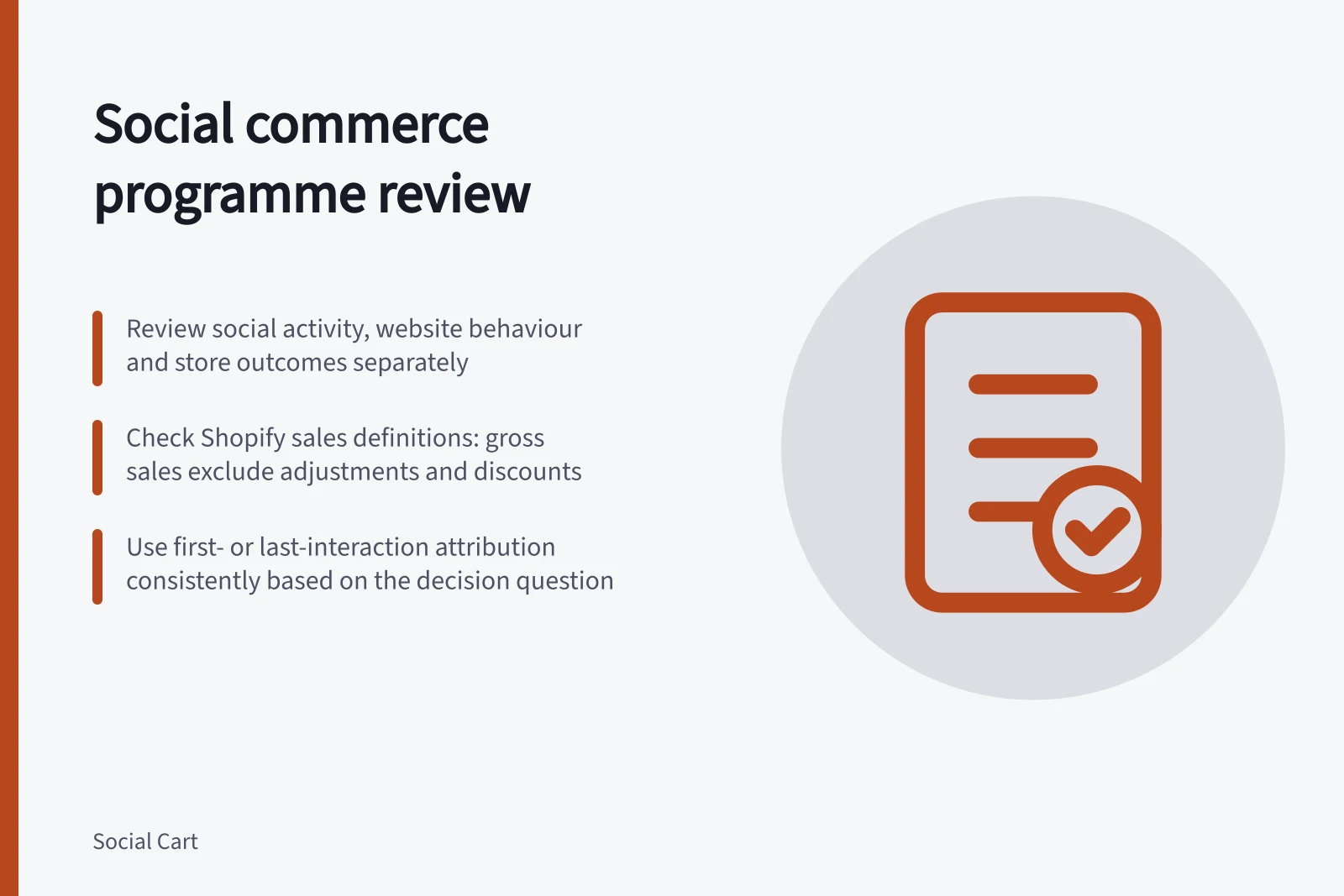
Check the measure’s definition before comparing results. In Shopify, gross sales are product price multiplied by quantity, before taxes, shipping, discounts and sales reversals. Gross profit is net sales less product cost, while average order value is gross sales, excluding adjustments, minus discounts, excluding adjustments, divided by the number of orders.
Shopify counts orders on the date they were placed. Its sales-report definition of adjustments includes edits, exchanges and returns made after an order is created, so a measure that excludes adjustments can differ from one that reflects them. State which measure is relevant to the decision and keep its definition consistent across the periods being compared.
Shopify Sales Report Metrics: Definitions and Use Cases
- Gross SalesProduct price × quantity, before taxes, shipping, discounts and adjustments
- Gross ProfitNet sales minus product cost
- Average Order Value (AOV)Gross sales (excluding adjustments) minus discounts (excluding adjustments), divided by number of orders
- Order DateDate order was placed; not affected by payment or fulfilment status
Interpret attribution within its limits
Shopify marketing reports summarise information from Online Store channel orders. They can describe which marketing channels are associated with customers and conversions, but their scope is not a complete record of every social interaction or every store outcome.
A referrer is the method a customer used to reach the store, such as a search or a link from an advertisement, email or website. Shopify categorises referrers as first interaction, which introduced the customer to the store, or last interaction, which the customer used just before ordering. The same customer can visit several times through different referrers.
First- and last-interaction views answer different questions: one identifies the recorded introduction, while the other identifies the recorded route immediately before purchase. A channel’s credit can therefore depend on the attribution view used. For campaigns run using marketing apps, Shopify directs retailers to marketing activity reports for campaign results; do not assume those are the same report as the general marketing reports.
First vs Last Interaction Attribution in Shopify Marketing Reports
- Pros of First-Interaction AttributionIdentifies which marketing channel introduced the customer to the store; useful for evaluating initial brand awareness campaigns
- Cons of First-Interaction AttributionMay overvalue early touchpoints if customers return later through different channels without conversion
- Pros of Last-Interaction AttributionHighlights the final step before purchase; useful for optimising checkout and conversion paths
- Cons of Last-Interaction AttributionIgnores earlier influence; may undervalue long-term brand-building efforts
Use report boundaries for the next decision
When a reported change appears, narrow it by the available sales-report dimensions, such as product, channel or time. Shopify also describes gross profit by product and sales by sales channel as report options. A change concentrated in one dimension gives the review a more specific question than a change in an overall total, but does not by itself establish why the change occurred.
Where payment status matters to the operating decision, check the relevant payment and order records alongside the sales report.
Consumer-facing accuracy is also a programme-level operating condition. The ACCC says businesses can be required to back up claims about products or services, and that it can investigate misleading claims and take compliance or enforcement action. If a material claim cannot be supported, resolve that before relying on the offer’s reported performance to justify continuing it.
Turn the review into decisions
Check the customer-facing offer first. Does the active content still match the item, price and delivery terms a shopper reaches? Check that material claims in active content can be supported, and correct any mismatch before extending the offer.
Then investigate the stage where evidence weakens. Product interest with few later buying actions calls for a product-level check. Product actions with few measured visits call for a route and measurement check. Site visits with little cart activity call for an offer and product-information check. These patterns identify questions, not causes.
Include the operating work: updating products, answering questions and resolving unavailable variants. Record the observed signal, its source and definition, the proposed action, its owner and the next review date.
Continue an accurate offer that meets the retailer’s chosen outcome; repair an identified fault; test when explanations remain uncertain; pause an offer that cannot be represented accurately. If systems cannot connect social actions to orders, present their totals separately.
Pre-Decision Checklist for Social Commerce Programme Reviews
- Verify customer-facing offer accuracyEnsure product details, pricing and delivery terms match what shoppers see
- Check material claims are supportedConfirm all promotional claims can be substantiated under ACCC guidelines
- Review measurement consistencyUse same report type, order-status rule and attribution model across comparison periods
- Assess operating workloadEvaluate time and effort required to maintain content, update variants and respond to queries
- Document findings and actionsRecord signal source, definition, proposed action, owner and next review date
In this guide
- Comparing social shop activity with real customer outcomesPut social shop actions, measured website behaviour and verified store outcomes side by side without treating taps as sales.
- Identifying products with interest but little purchase intentShortlist products attracting inspection but little buying progression, then check the offer, route and measurement before drawing conclusions.
- Deciding whether to improve content or the shopping journeyInspect the first weak handoff between a social post and purchase, then assign a focused content or shopping-route fix.
- Testing a new social commerce format before a wider rolloutDefine the format, outcome, stop conditions and comparison method for a small social commerce pilot before expanding it.