Platform Selection
Part of Social commerce platform selection
Reviewing platform dependence before investing in a social shop
Map account, catalogue and product-review dependencies, then decide how much platform-specific work a social shop justifies.
Before investing, map how Facebook and Instagram by Meta and YouTube Shopping depend on connected accounts, product publishing and displays. Compare each platform-dependent buying step with a product page and checkout the retailer controls, then cap spend on work that would lose value if a platform feature became unavailable.
Reviewing Platform Dependence Before Investing in a Social Shop
- Map dependencies across account, catalogue and product review
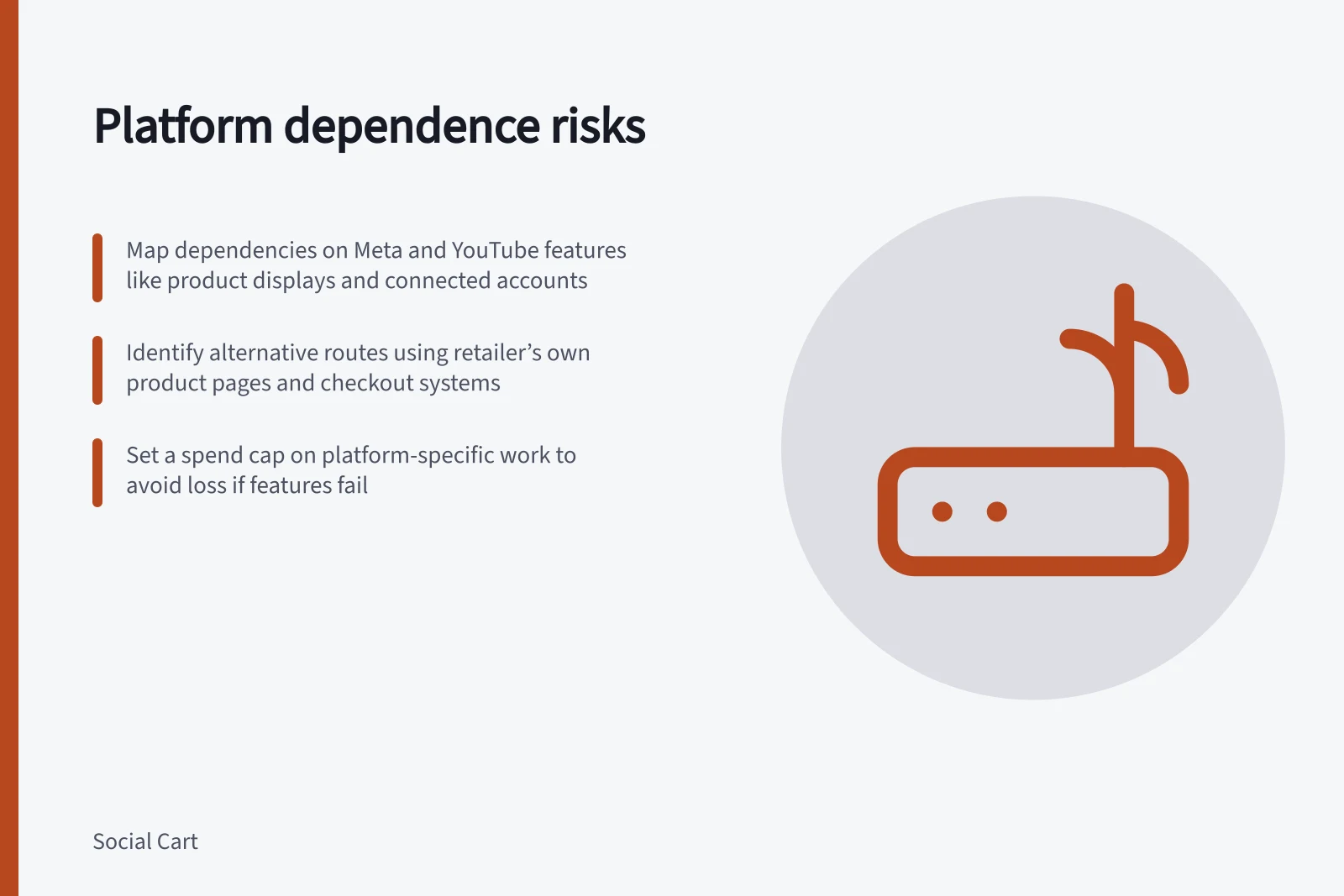
- Identify platform-specific features reliant on Meta or YouTube accounts
- Design alternative routes using retailer’s own product pages and checkout
- Set investment limits for platform-specific work
- Ensure claims and buying actions remain accurate under ACCC guidelines
Map the dependencies
List the proposed content, product display, destination and checkout. For each stage, record who controls it, who can correct it and what customers would see if it became unavailable. Separate reusable store records and checkout from features that depend on a platform account, rules or product review.
For Facebook and Instagram by Meta, check Shopify’s “Requirements and considerations for using Facebook and Instagram by Meta” and “Publishing products on Facebook and Instagram by Meta”. Record whether the proposed route relies on a connected account, publishing products or a native product display, and what customers would see if any step became unavailable.
For YouTube Shopping, record which products from the connected store depend on YouTube product displays and which purchase routes rely on those displays. Check YouTube’s “Manage products from your store on YouTube” guidance and current requirements before relying on them; note the customer-facing effect if a product cannot be shown.
Platform Dependencies: Facebook & Instagram by Meta vs YouTube Shopping
- Connected Account Required
- Yes (Meta)
- Product Publishing Required
- Yes (Meta)
- Native Product Display
- Yes (Meta)
- YouTube Product Display Required
- Yes
- Customer View if Unavailable
- Redirect to store or no product shown
Design a usable alternative
For each product the plan depends on, identify its product page in the retailer’s store and the store checkout as an alternative route. Check that the page presents the same item, price, availability and relevant delivery terms.
A homepage link may make shoppers search again for a specific product. Where content names one item, use its product page as the destination, test it on a mobile device and assign an owner to keep its details and availability current.
Key Actions to Reduce Platform Dependence Risk
- Confirm product page matches item, price and availability✓
- Use direct product page links instead of homepage search✓
- Test mobile accessibility of alternative route✓
- Assign owner to maintain product details and stock status✓
Set an investment limit
Separate reusable work, such as accurate store product records and a maintained checkout, from platform-specific work such as product tagging routines, separately curated collections and custom feed mappings. Set a dollar ceiling for platform-specific setup and maintenance before committing, and count one-off and ongoing costs against it.
For each platform-specific investment, record its owner, the feature it depends on, a review trigger and the response if that feature becomes unavailable. Recheck the plan if account access changes, a product cannot be published or a display becomes unavailable; approve work only within the retailer’s ceiling and with a usable alternative route.
Prioritise dependencies that could leave an active claim or buying action inaccurate. The ACCC advises businesses to avoid false or misleading claims and says it can require them to back up claims made on social media. Include the work needed to keep claims and buying actions accurate when deciding what to fund.
Investment Limits and Platform-Specific Costs
- Reusable Work (e.g. product records, checkout)
- Low risk, high reuse
- Platform-Specific Work (e.g. tagging, feed mapping)
- High risk, limited reuse
- ACCC Compliance Requirement
- Back up all social media claims
- Recommended Investment Ceiling
- Set per platform, track ongoing costs