Platform Selection
Social commerce platform selection
Choose a social shopping route by comparing customer actions, eligibility, product control, checkout and the work needed to maintain it.
Choose a social shopping platform by the action customers need, the products the retailer can keep accurate, and the buying route the team can maintain.
For an Australian retailer, a feature described in platform documentation is a candidate until its availability and customer view are confirmed for the actual account.
Define the buying action
Decide whether a shopper needs to open an item shown in a post, browse a range on a social profile, or inspect products featured in a video. Then identify where the shopper will pay. A catalogue connection, a visible product tag and a completed order are different capabilities.
Shortlist a route only if the proposed feature suits the customer task, the business and products meet its requirements, and the destination presents the advertised offer. A direct link to a suitable store page may be enough when a native shopping feature is unavailable.
Australian consumer behaviour in social commerce
- Australians using social media to research brands
- 60%
- ACCC enforcement focus on misleading claims
- Active investigations into social media promotions
- Marketplace oversight concerns
- Growing scrutiny over mobile phone market transparency
Compare documented routes
Facebook and Instagram through Shopify. This route can suit a retailer that wants an eligible social shop and already maintains its products in Shopify. Shopify’s Meta channel uses a single product catalogue for shops on Facebook and Instagram.
For stores outside the United States, Shopify collections do not sync to Facebook; Facebook collections can be created in Commerce Manager. Commerce eligibility, supported location, product rules and the purchase domain still need checking.
YouTube Shopping through Shopify. This route can suit a retailer whose eligible channel uses product demonstrations in videos or live streams. For merchants outside the United States, Shopify says a shopper selecting a product is sent to the online store; its YouTube in-app checkout is limited to the United States.
Screen account-level gates early
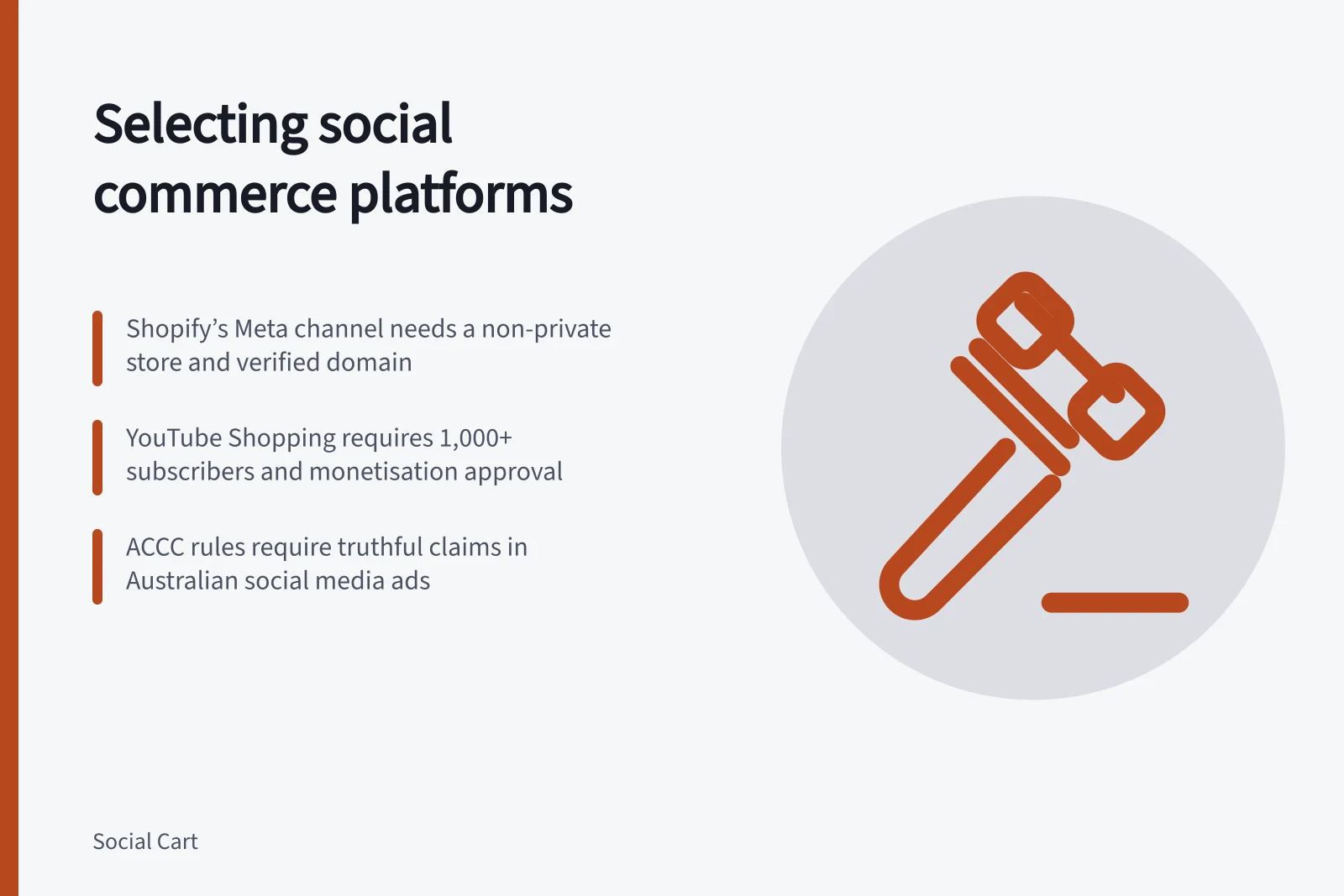
Treat Meta Commerce eligibility as distinct from installing Shopify’s Facebook and Instagram channel. The Shopify route requires a non-private online store and connected business assets; a shop also depends on Meta’s commerce rules, a supported location and products available for direct purchase from a verified domain.
For YouTube Shopping, check that the channel has at least 1,000 subscribers, is approved for monetisation, and is in a supported YouTube Partner Program country. The channel account email also needs owner or manager access to the channel and full permissions through a matching Shopify staff account.
Set a deliberate launch boundary
Choose an initial scope that the team can support across the customer journey, rather than treating an approved connection as a finished shopping experience. Agree which customer action the launch is intended to support and which route customers will use to complete a purchase; keep any essential route out of scope until its relevant account and product gates are met.
For Meta, plan product availability across the features connected to its shared catalogue. Shopify says a product made available to Facebook and Instagram is available across the Meta features set up for the merchant, rather than being selectable for only one of them.
Factor in where the team will manage orders, returns and payments when deciding whether a route fits its operating model. Shopify says YouTube Shopping orders, returns and payments can be managed in Shopify admin, while Australian customers selecting YouTube products are redirected to the online store to complete their purchase.
Make a selection record
| Decision | Evidence needed |
|---|---|
| Customer action | The exact shop, tag or video action that helps someone choose |
| Eligibility | The account, market and product requirements still to be confirmed |
| Product control | Where the current item and offer originate, and who fixes an error |
| Checkout | Where the shopper reviews the order and pays |
| Dependence | What the team would do if the feature or product display became unavailable |
Hold an essential feature if a requirement fails. If more than one route qualifies, compare the work needed to maintain a small product set and its buying paths.
Before launch, inspect the proposed action from a customer view in the intended Australian market. A merchant status screen and a public product display answer different questions.
Include claims governance in the decision
The ACCC can require businesses to back up claims they make on social media and may investigate or take compliance or enforcement action if a business makes false or misleading claims in social media advertising.
Include responsibility for checking that social posts, product displays and store offers remain consistent in the launch scope, particularly when customers move from a platform to the retailer’s store to complete a purchase.
In this guide
- Comparing supported shopping features with the store's needsMatch product tags, collections and video shopping features to the customer action your store needs, with their documented limits.
- Checking merchant eligibility before implementationCheck business assets, account access, market and product requirements for the exact social shopping feature before implementation.
- Reviewing platform dependence before investing in a social shopMap account, catalogue and product-review dependencies, then decide how much platform-specific work a social shop justifies.