Social Service
Social commerce customer service
Route social shopping questions, handle order issues privately, protect customer details and improve product information.
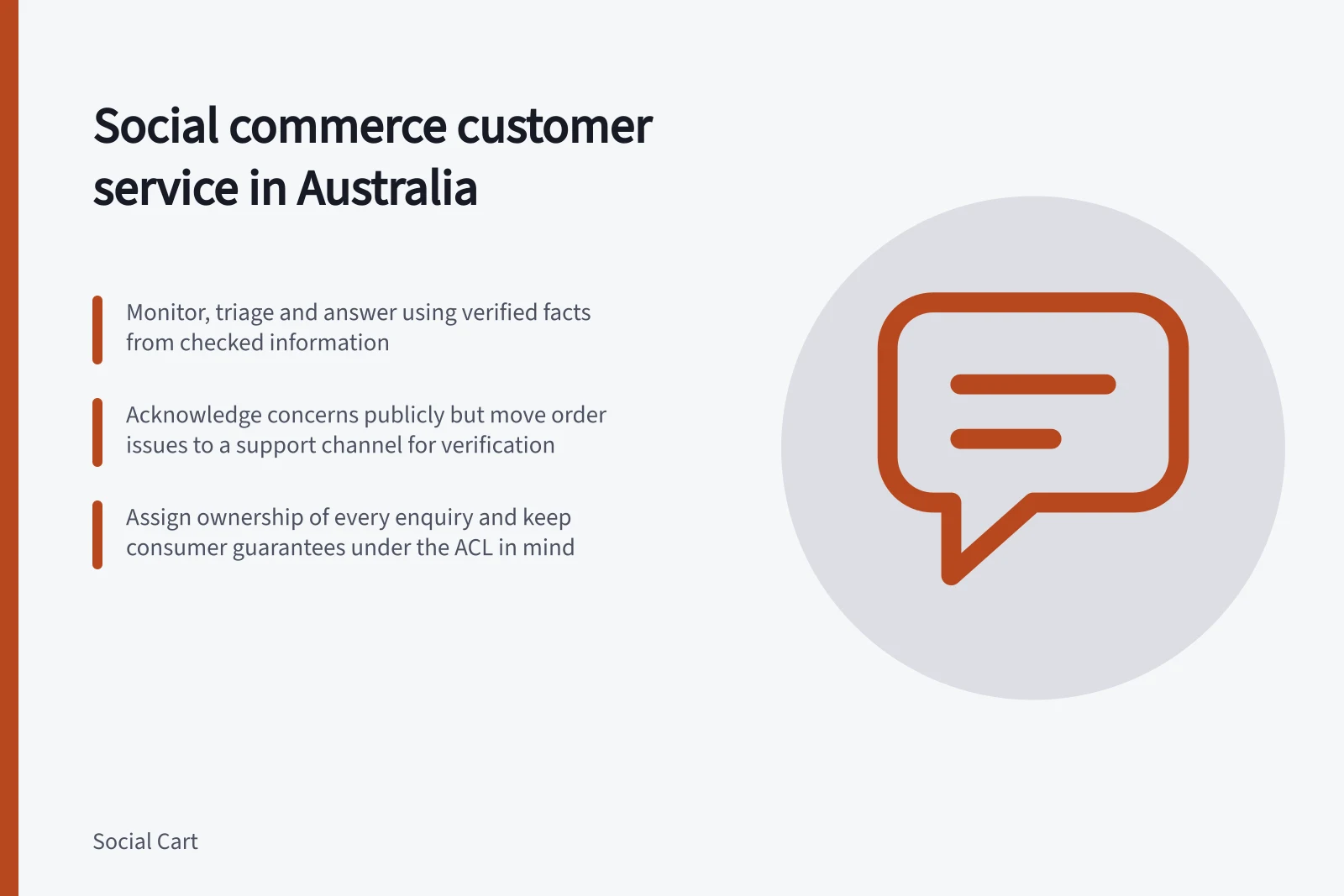
Social commerce customer service needs three clear routes: answer general buying questions where they arise, move individual order problems to a support channel that can verify the customer, and give every enquiry an owner.
A public comment can clarify a product. It should not become a place to investigate someone’s payment, address or delivery history.
For an Australian retailer, the operating loop is to monitor, triage, answer from checked information, assign an owner and feed recurring questions into product information.
Route each enquiry
| Enquiry | Public response | Next step |
|---|---|---|
| General product question | Give a verified answer that helps other shoppers | Point to fuller product information when useful |
| Question requiring personal details | Acknowledge it without requesting those details | Continue through the retailer’s established support channel |
| Order or payment problem | Acknowledge the concern without discussing the order | Verify the customer and investigate through support |
| Possible product fault | Acknowledge and record the concern | Assess the facts and any applicable remedy through support |
Assign ownership of comments, messages and support cases, including cover when the usual responder is away. Give staff a route for escalating a reported safety concern.
Social media supports real-time customer interaction, but each channel takes time and effort to manage. Set monitoring and cover to match the channels the business can manage well, rather than spreading response capacity too thinly.
Set an internal response expectation for each channel and make clear who covers it when the usual responder is away. Keep the escalation route for a reported safety concern clear to everyone handling enquiries.
Answer from checked facts
Identify the product and variant before replying. Check specifications, current offers and relevant conditions.
For delivery questions, use the information that applies to the shopper’s destination and describe an estimate as an estimate.
If an answer is uncertain, verify it rather than guessing. Keep product facts current and make someone responsible for updating them when an offer or variant changes.
The Australian Consumer Law (ACL) requires businesses selling goods and services in Australia to give truthful information about them. The ACL is part of the Competition and Consumer Act 2010.
Keep claim evidence accessible
The ACCC can require a business to back up claims about its products or services. Make sure the staff member answering can locate the information that supports a claim, or knows who can check it before a reply is sent.
The ACCC accepts reports about possible misleading claims and uses them to inform its education, compliance and enforcement work. It does not resolve individual disputes about misleading claims, so a report to the ACCC is not a substitute for assigning an owner to the customer’s case.
Hand over order problems
Acknowledge the concern publicly and direct the customer to a genuine, monitored support route. Do not request an address, card details or order documents in the thread.
The support team can verify the customer through its usual process, investigate and explain the next step.
Record the issue, the case owner, any promise made and when the customer should next hear from the team. Consumer guarantees are rights under the Australian Consumer Law (ACL), which is part of the Competition and Consumer Act 2010. A complaint about a faulty product needs an assessment of the facts and applicable guarantees.
If the customer seeks external help, state and territory consumer protection agencies manage individual complaints and may offer voluntary dispute services. The ACCC deals with widespread issues, but does not resolve individual disputes.
If personal information has appeared in the public thread, deal with that exposure as well as the complaint. Avoid repeating the details in public replies, and do not use reduced visibility of private details to erase a complaint merely because it is critical.
Key Consumer Rights Under the Australian Consumer Law (ACL)
- Right to a Repair, Replacement or Refund
- For faulty or unsatisfactory goods under ACL
- Truth in Advertising
- All claims must be accurate and substantiated
- No Misleading Claims
- Businesses must back up claims with evidence
Improve the information shoppers see
Record recurring pre-purchase questions by topic, product and variant without carrying customer identifiers into a content backlog. Check whether the gap belongs in a product description, specification, image or help content. Verify the answer and its conditions before updating the page or post.
Assign an owner to verify and publish each proposed correction, then check the updated information against the product and its conditions.
Review later questions to see whether shoppers can now find the answer. A change in question volume is a useful signal, but traffic, promotions and product changes can affect it too.
Use social listening to identify emerging concerns about the business, then route specific customer cases to their owners.
Top 5 Reasons to Improve Product Information Based on Social Feedback
- Recurring pre-purchase questionsIndicates missing or unclear information
- High volume of complaints about delivery timesSuggests need for clearer shipping estimates
- Frequent confusion over return policiesRequires updated help content or policy page
- Misunderstandings about product featuresCalls for improved images or specification tables
- Inconsistent pricing across platformsNeeds centralised offer management
In this guide
- Answering buying questions in comments and messagesDecide when to answer a shopping question publicly, when to use support and how to keep product replies accurate.
- Moving an order problem into a secure support channelHand an order complaint from a public social thread to verified support with clear ownership and careful records.
- Keeping private order details out of public commentsAvoid exposing order details in social comments and respond carefully when a customer has already posted private information.
- Recording questions that product content should answerTurn recurring social shopping questions into verified product information without copying private customer details.